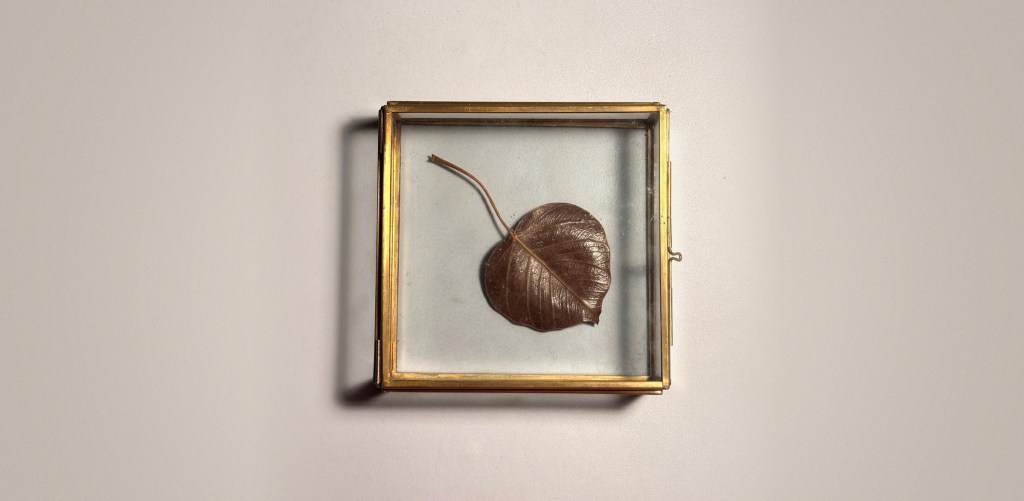
This is a heartfelt gift from a woman whom I deeply admire, respect and see as a guru. It is actually a leaf from the Bodhi tree, where Lord Buddha attained enlightenment. I have preserved it in a beautiful glass box. Just yesterday evening, when I opened the Chandogya Upanishad book that was underneath it to read, I noticed the leaf inside the box, and a new realization dawned on me. I am sharing it with you.
At first glance, this is just a leaf. Like all leaves in nature, it is indeed a leaf. But there is something unique about it. Lord Krishna has given a very important place to the Ashwattha tree in the Bhagavad Gita. The 26th verse in Chapter 10 – Vibhuti Yoga is as follows.
अश्वत्थ: सर्ववृक्षाणां देवर्षीणां च नारद: |
गन्धर्वाणां चित्ररथ: सिद्धानां कपिलो मुनि: || 26||
aśhvatthaḥ sarva-vṛikṣhāṇāṁ devarṣhīṇāṁ cha nāradaḥ
gandharvāṇāṁ chitrarathaḥ siddhānāṁ kapilo muniḥ
He claims to be the Ashvattha tree among trees. The Ashvattha tree is often called the King of Trees, and there’s a good reason for that: it produces the pure oxygen we need all year round, every hour of the day. Isn’t this leaf the key to it all? Generally speaking, other trees only release oxygen during the day when they undergo photosynthesis, right? You might wonder, what makes this tree so special? Naturally, each living being and organism is different. If you ask how one can differentiate this specific tree, the answer leans a little towards spirituality.
This leaf introduces us to the lesson of life in a very simple and easy way: every living being must die after being born. Life is the interval between birth and death, and how we live it becomes important. Look at this leaf. How many leaves can there be on a Bodhi tree? Have you ever seen them competitive with each other? A leaf never thinks of itself as separate from the tree until it falls from the branch and becomes soil in the ground; it is a part of the tree and of nature. Even after it dries up and crumbles to the ground, it rejoins the soil and becomes a part of nature again. But the work it completes from the day it emerges or is born on a branch until it dries up and crumbles to the ground is an example for us.
We have all studied science. We know that all plants and trees absorb carbon dioxide from the atmosphere and release oxygen. Similarly, the Bodhi tree also does its part. Because of this great work, many living beings are able to thrive on this earth. It performs such virtuous work. The leaves play a major role in this noble effort of the tree. They help sustain many life forms by releasing the life-supporting air, while absorbing the poisonous gas. But have we ever seen it display arrogance? Have we ever seen it fight against the tree that supports it? Have we ever experienced them protesting against us? Are there any examples of them ever being racist or sexist?
From its birth, it withers, becomes weak, dries up, and crumbles into dust until it becomes a part of nature. It does not rejoice at birth. It is not proud in its youth. It does not grieve when it dies, nor does it long to cling to the same branch of the tree.
If we look very closely, aren’t we also like a leaf? A leaf that supports so many living beings and finds fulfillment in its work without any distortion. On the contrary, we are living without being beneficial to others in any way, being arrogant, causing uneasiness to others, causing harm to other living beings, and being a burden to the rest and to the earth. The root cause of this is that we live apart from nature, without understanding the significance and reason for our birth and death, without knowing the purpose of life.
Just as a leaf breathes poison and exudes life force to nourish other living beings, so too was our life born for the same purpose. The basic purpose of our birth is to absorb the negativity in this world, live positively, and spread positivity among others, thus becoming a guiding force for the generations that come after us and instilling these same qualities in them as well.
Just as a leaf embraces and dedicates itself to the Bodhi tree, becoming part of the tree and playing a vital role in bringing greater life to nature, similarly, if we too live in a way that enriches our people around us, our home, our village, our state, our country, and ultimately the entire earth, then nature will surely bless us. Let this Ashwaththa leaf be the example or the reason for this.
ॐ आप्यायन्तु ममाङ्गानि वाक्प्राणश्चक्षुः
श्रोत्रमथो बलमिन्द्रियाणि च सर्वाणि।
सर्वम् ब्रह्मोपनिषदम् माऽहं ब्रह्म
निराकुर्यां मा मा ब्रह्म
निराकरोदनिराकरणमस्त्वनिराकरणम् मेऽस्तु।
तदात्मनि निरते य उपनिषत्सु धर्मास्ते
मयि सन्तु ते मयि सन्तु।
ॐ शान्तिः शान्तिः शान्तिः॥
Oṃ āpyāyantu mamāṅgāni vākprāṇaścakṣuḥ
śrotram atho balam indriyāṇi ca sarvāṇi |
sarvam brahma upaniṣadam mā’haṃ brahma
nirākuryāṃ mā mā brahma
nirākarodanirākaraṇamastvanirākaraṇam me ‘stu |
tadātmani nirate ya upaniṣatsu dharmāste
mayi santu te mayi santu |
oṃ śāntiḥ śāntiḥ śāntiḥ ||
– Shanti Mantra, Kena and Chandogya Upanishads
(Om, may my limbs, speech, breath, eyes, ears, strength, and all my senses be strengthened. May I not deny Brahman (nature), and may Brahman (nature) not deny me. Let there be no negation; let there be no negation from me either. Let the dharmas mentioned in the Upanishads be in me, the one who is self-absorbed; let them be in me.
Om Peace Peace Peace )
 Silent Seeker
Leave a comment